
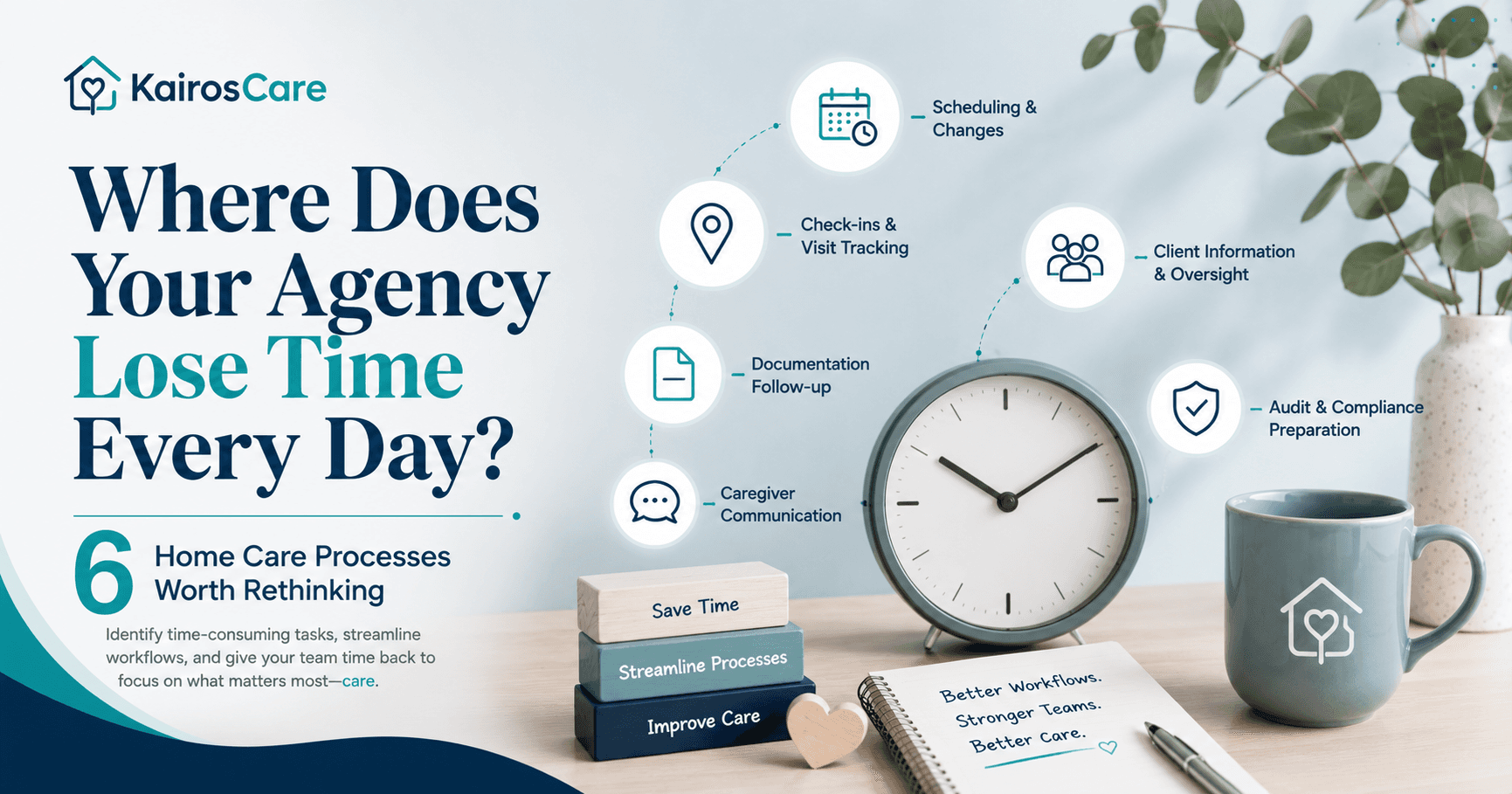
Where Does Your Agency Lose Time Every Day? 6 Home Care Processes Worth Rethinking
Running a home care agency means keeping a lot of moving pieces together.
There are caregivers to coordinate, visits to track, documentation to review, families to communicate with, and compliance requirements to stay on top of.
None of these tasks are unusual. In fact, they're part of running a home care agency.
But when too many of them still depend on manual work, small inefficiencies can quickly add up.
A few extra minutes spent checking a visit. Another phone call to confirm an update. Another message asking a caregiver to complete a note.
One task doesn't seem like much.
Multiply it across dozens—or hundreds—of visits, and suddenly your team is spending hours managing processes instead of focusing on the work that matters most.
Here are six home care processes worth taking a closer look at.
1. Scheduling and Last-Minute Changes
Schedules rarely stay exactly as planned.
When scheduling depends heavily on calls, texts, spreadsheets, or multiple systems, even a small change can create a chain of extra work.
Ask yourself: How much time does your team spend every week coordinating changes that could be handled more efficiently?
2. Caregiver Check-Ins and Visit Tracking
Knowing whether a caregiver arrived for a scheduled visit is important for both operations and accountability.
But if staff have to manually confirm arrivals, review times, or chase down missing information, a simple check-in can become another administrative task.
A smoother process can capture visit details as they happen, giving the agency better visibility without requiring someone in the office to constantly follow up.
3. Chasing Documentation
Documentation is essential to home care.
But collecting it shouldn't mean repeatedly asking:
“Did you finish your note?”
When documentation is incomplete, delayed, or difficult to find, coordinators may have to spend time tracking it down.
That creates extra work for everyone—and can make it harder for agencies to maintain a clear record of the care being provided.
The goal isn't to reduce documentation. It's to make the process of completing, organizing, and reviewing it easier.
4. Keeping Caregivers and Office Staff on the Same Page
A caregiver has an update. The coordinator needs to know about it. Someone needs to communicate with the family. Another staff member may need to follow up.
When information moves through separate phone calls, texts, emails, and messages, it's easy for communication to become fragmented.
The more people involved in a client's care, the more important it becomes to have a clear place for information to live.
Good communication shouldn't depend on someone remembering to pass along a message.
5. Piecing Together What's Happening Across Your Clients
Managing one client's information is one thing.
Managing information across an entire agency is another.
Agency leaders need to understand what's happening across their client population, but finding meaningful information can take time when staff have to manually review records one by one.
The challenge isn't necessarily having too little information.
Sometimes, it's having too much information in too many places.
The right systems should make important information easier to see—not create another place for staff to search.
6. Preparing for Audits and Compliance Reviews
No agency wants to spend days searching through records when an audit or compliance review comes around.
But when documentation is scattered across different systems, files, or paper records, pulling everything together can become a major administrative project.
Keeping organized records from the start can make the process much easier.
Instead of scrambling to build a paper trail later, agencies can work toward maintaining clear, accessible documentation as part of their everyday workflow.
The Bigger Question: Where Is Your Team Spending Its Time?
None of these processes are unnecessary.
Scheduling matters. Check-ins matter. Documentation matters. Communication matters. Compliance matters.
The question is whether your team has to spend more time than necessary managing them.
When routine processes require constant manual follow-up, the cost isn't always obvious.
Over time, those minutes become hours.
And those hours could be spent supporting caregivers, communicating with clients and families, or improving the quality of care your agency provides.
What Could Be Automated?
Not every process needs to be completely automated.
But many routine tasks can be made simpler by using technology to capture information as work happens, reduce duplicate entry, and keep everyone working from the same information.
That's where a connected platform can make a real difference.
A More Connected Way to Manage Home Care
KairosCare is designed to help home care agencies reduce the administrative friction that comes with managing care.
Caregivers can check in through the platform, with visit details captured automatically. During the visit, they can document information in real time without relying on separate paperwork or disconnected processes.
That information is then organized into a structured format that agencies can use to monitor care across their clients.
Instead of constantly chasing information, agency teams can have greater visibility into what's happening.
And because the information is already being captured as part of the workflow, agencies can build a more complete and accessible record of care—without adding another layer of manual work.
More Time for What Actually Matters
Technology shouldn't make home care feel more complicated.
It should take some of the unnecessary work off your team's plate.
By rethinking the processes that consume time every day, agencies can create smoother workflows for caregivers, better visibility for their teams, and a more connected experience for the people they serve.
The goal isn't to eliminate the work that matters.
It's to spend less time managing the work—and more time improving care.