
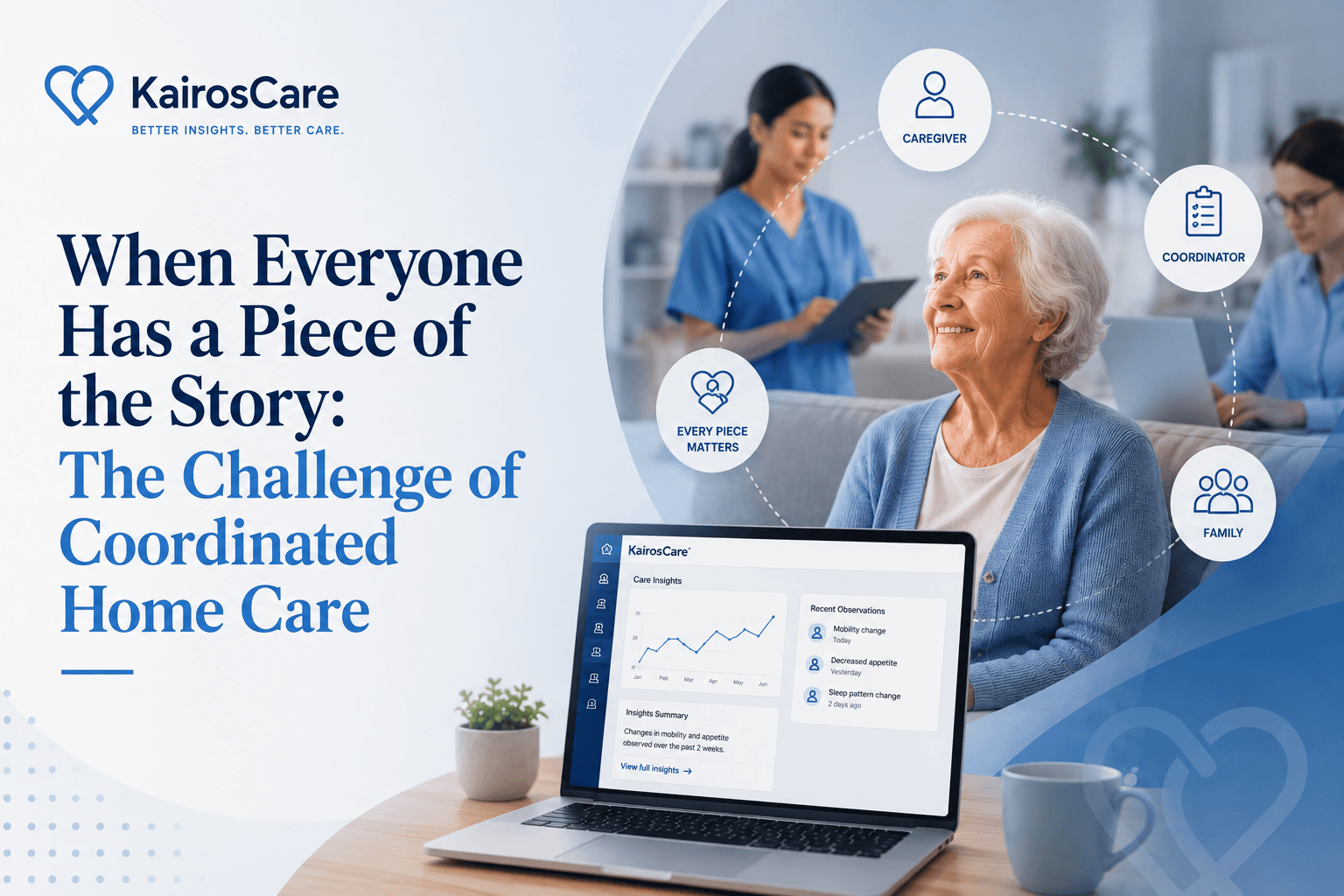
When Everyone Has a Piece of the Story: The Challenge of Coordinated Home Care
Home care rarely involves just one person.
A caregiver sees the client during a visit. A coordinator manages schedules and documentation. A family member may notice changes at home, while another caregiver sees something different a few days later.
Everyone may have valuable information.
The challenge is making sure those pieces come together.
When information stays in separate conversations, notes, messages, or systems, it can be difficult for the people managing care to see the full picture. And as an agency grows, keeping everyone connected becomes even more important.
Care Doesn't Happen in Isolation
A client may have several caregivers throughout the week, each seeing a different part of their daily routine.
One caregiver might notice that the client is moving more slowly. Another might notice a change in appetite. A family member may mention that the client hasn't been sleeping well.
None of these observations necessarily tells the whole story on its own.
But together, they can provide valuable context about how a client is doing over time.
The challenge is making sure that information doesn't stay with the person who happened to notice it.
When Information Gets Fragmented
Communication in home care can happen through many different channels:
Caregiver notes
Phone calls and text messages
Emails
Family updates
Office records
Conversations between staff
Each has its place. But when important information is scattered across different places, it becomes harder to maintain a complete picture.
A caregiver may document something in a visit note while a family member tells the coordinator something by phone. Someone then has to remember, find, or communicate that information again.
The more often information has to be passed from one person to another, the more opportunities there are for details to be missed.
The More People Involved, the More Important Continuity Becomes
Having multiple people involved in a client's care isn't a problem. In fact, different caregivers and family members can provide a broader view of what's happening.
The challenge is maintaining continuity between those different perspectives.
As an agency grows, there may be dozens of caregivers and hundreds of visits happening every week. Expecting everyone to remember every detail simply isn't realistic.
Instead, the information needs to move with the care.
The next person involved shouldn't have to start from zero.
What Better Coordination Can Look Like
Good coordination isn't necessarily about making everyone communicate more.
It's about making the right information available to the right people when they need it.
A more connected approach can help agencies:
Keep caregiver observations organized
Maintain a clearer record across visits
Give coordinators better visibility
Reduce unnecessary follow-ups
Keep families better informed
Make changes easier to understand over time
The goal isn't to give everyone more information.
It's to make sure the important information is accessible and useful.
From Individual Observations to the Bigger Picture
Consider a client whose care involves several caregivers.
One caregiver notices a change in mobility. Another documents a change in appetite. A third notices that the client seems less engaged than usual.
If each observation remains isolated, each one may appear relatively minor.
When those observations are connected over time, however, they can provide a more complete picture.
This is why the way information is captured and organized matters. The value isn't only in documenting what happened during one visit. It's also in being able to understand those observations together.
Technology Can Help Connect the Pieces
Technology can't replace communication, experience, or the judgment of the people providing care.
But it can help make information more connected and easier to access.
When caregiver observations and visit information are captured consistently, agencies have a stronger foundation for understanding what's happening across their clients.
Instead of information living in separate places, it can become part of a shared, structured record.
And when that information can be analyzed over time, teams can look beyond individual notes and begin to identify patterns and changes across visits.
Where KairosCare Fits In
This is where KairosCare can help.
Caregivers can check in and document observations during their visits, with information captured in a structured format. That information can then be organized and analyzed across clients rather than remaining isolated in individual visit notes.
KairosCare helps agencies gain greater visibility into what's happening across their client population, while families can receive updates that keep them more connected to the care being provided.
Instead of asking your team to manually connect every piece of information, KairosCare helps bring those pieces together.
Better Coordination Starts With Better Visibility
Coordinated care doesn't mean everyone needs to know everything.
It means important information shouldn't get lost between people, visits, or systems.
When caregivers, agency teams, and families can work from a more connected picture, communication becomes easier and decisions can be made with better context.
Because in home care, no single person always sees the whole story.
The goal is to make sure the people responsible for care can see enough of it to understand the bigger picture—and act when it matters.