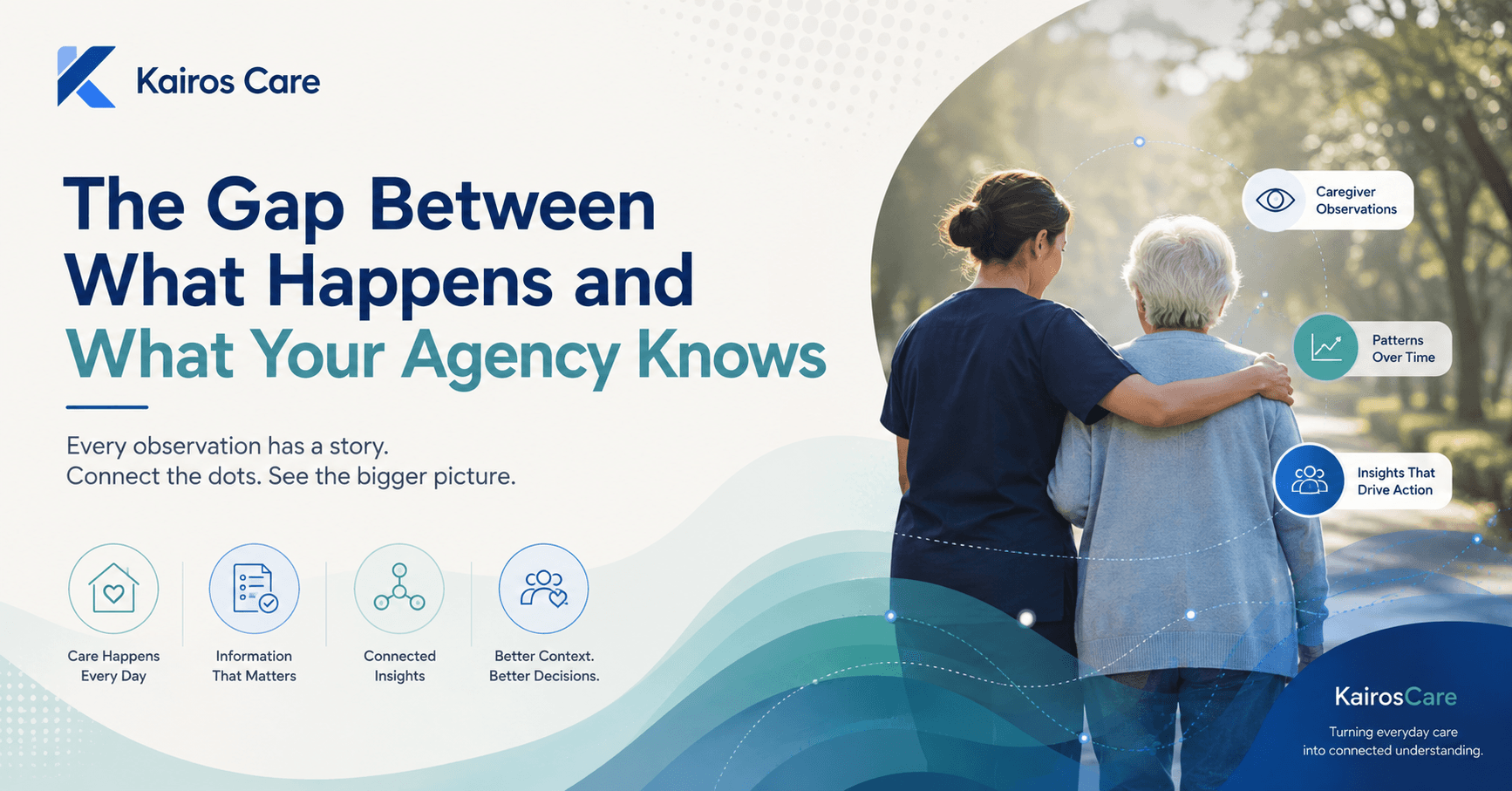
The Gap Between What Happens and What Your Agency Knows
A lot happens during a home care visit. A caregiver may notice that a client seems quieter than usual, isn't finishing meals, or is having more difficulty moving around. These observations may seem small on their own, but they can become important when viewed alongside what has happened during previous visits.
The caregiver may document what they noticed. But what happens next?
Does that information quickly reach the people managing the client's care? Does someone have the context to understand whether it's a one-time observation or part of a larger pattern? Or does it simply become another note sitting inside a client record?
This is where a gap can develop between what happens in the home and what the agency knows about it.
Care Is Happening Every Day. Is Your Agency Seeing All of It?
Home care agencies rely on caregivers to provide hands-on care, but caregivers are also observing clients throughout their visits. Every visit creates information that can help the agency understand how a client is doing.
The challenge is making sure that information doesn't stop at documentation.
For it to be truly useful, information needs to be:
Captured consistently
Accessible to the right people
Connected to the client's history
Easy to understand in context
Without that connection, different people may each have a piece of the story without anyone having the full picture.
Small Details Can Become Meaningful Over Time
Not every change is an emergency.
A client eating less during one visit may not immediately indicate a serious concern. Neither might a single observation about mood, mobility, or behavior.
But what if the same change appears during several visits?
One observation may not tell you much. Several related observations over time can provide a much clearer picture of what's happening.
That's why looking at information individually isn't always enough. Agencies need ways to understand how observations connect and whether patterns are beginning to emerge.
The value isn't just in recording what happened. It's in being able to understand what those records reveal together.
Where the Gap Can Grow
As an agency gets busier, information becomes harder to connect.
There may be dozens of caregivers documenting visits, hundreds of client records, and constant communication between caregivers, coordinators, families, and other members of the care team.
At the same time, your staff are already managing schedules, documentation, follow-ups, and day-to-day operations.
When connecting information depends heavily on manual review, phone calls, messages, or someone's memory, important details can become delayed, scattered, or overlooked.
The bigger the agency becomes, the harder it is to rely on processes that depend on everyone knowing what's happening.
Closing the Gap Doesn't Mean Adding More Work
The answer isn't necessarily asking caregivers and office staff to document more.
In fact, adding more steps can create even more administrative pressure.
The better approach is to make the information your team is already collecting more connected and useful.
That means capturing information as part of the normal workflow, organizing it consistently, and making it easier for the people who need it to understand what's happening.
Technology can help bridge that gap without requiring your team to constantly chase information.
Where AI Can Help
This is one area where AI can provide value.
Instead of asking someone to manually review every note across every client, AI can help analyze large amounts of structured information and identify patterns that may deserve attention.
It doesn't replace the caregiver's judgment, and it doesn't make the care decision for the agency.
It helps the team see more of the information they already have.
That can make the difference between simply having a record of what happened and having a clearer understanding of what may be happening.
From Individual Visits to the Bigger Picture
Imagine being able to look beyond one caregiver's note or one visit.
Your agency could have a clearer view of:
Changes occurring across multiple visits
Recurring observations from different caregivers
Patterns developing over time
Information that may deserve a closer look
The broader picture of what's happening across your clients
This doesn't mean every change requires immediate action.
It means your team has more context when deciding where attention may be needed.
How KairosCare Helps Connect the Dots
This is where KairosCare comes in.
KairosCare helps connect what happens during caregiver visits with the information agency teams need to understand and manage care. Caregivers can document observations in real time, while information is captured in a structured, analyzable format.
That information can then be analyzed across clients to help surface patterns and bring potentially important changes to the attention of the care team.
Instead of information remaining isolated inside individual visit notes, KairosCare helps agencies build a more connected picture of care.
The goal isn't to create more work.
It's to make the work your team is already doing more useful.
Closing the Gap
Every day, caregivers are seeing things that matter. Every visit creates another piece of information, and every observation can contribute to a client's larger care story.
The question is whether that information stays inside a single visit record—or becomes part of a bigger picture your agency can actually use.
Because the gap between what happens and what your agency knows doesn't have to be so wide.
With the right systems, everyday observations can become connected information, giving your team more context, better visibility, and a stronger foundation for informed care decisions.