
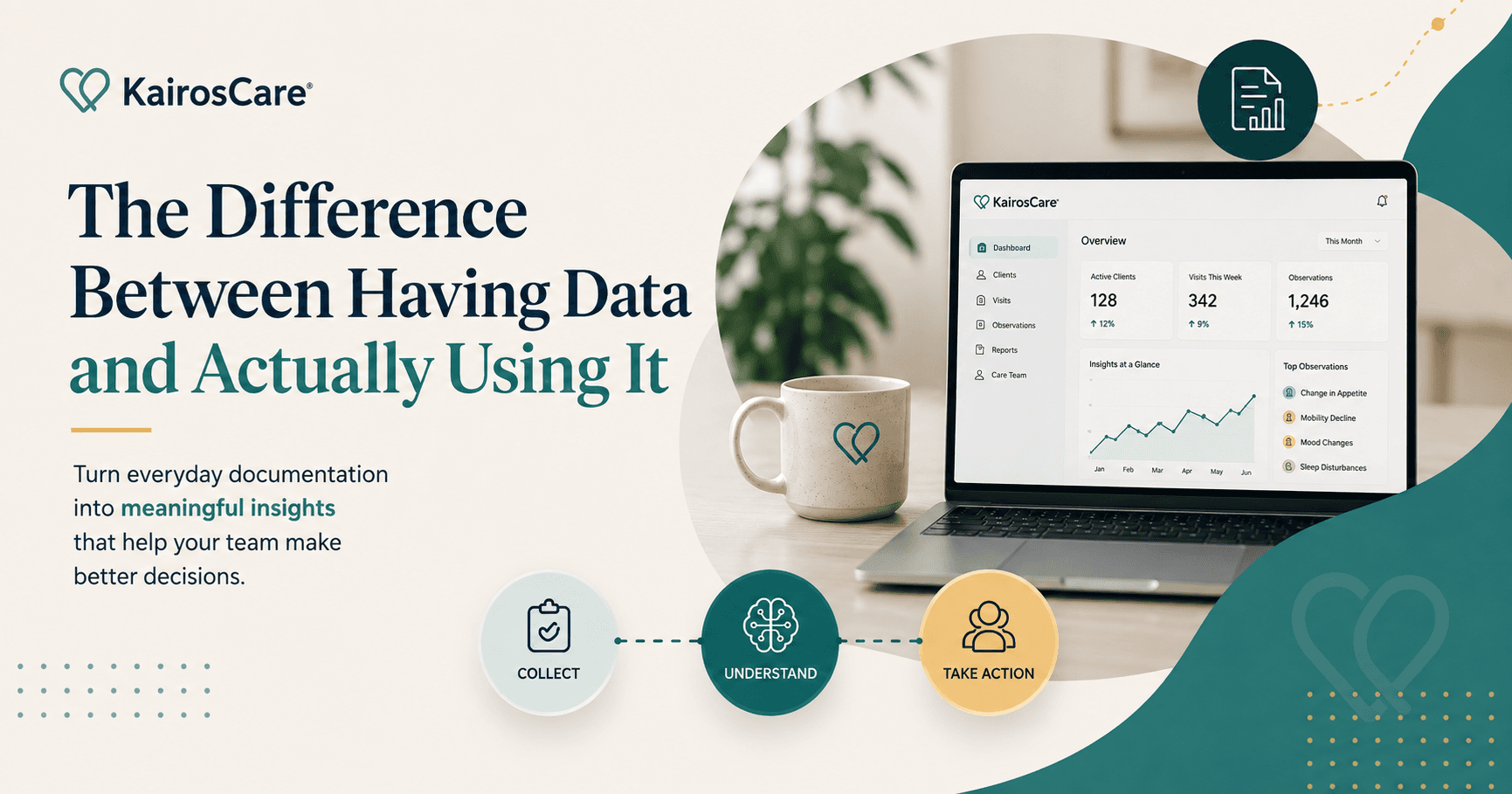
The Difference Between Having Data and Actually Using It
Home care agencies collect information every day. Caregivers document visits, records are updated, and teams communicate about what's happening in the home.
All of that information matters. But having information and knowing how to use it are two different things.
As agencies grow, the amount of data grows with them. When teams have to manually search through records, compare notes, and connect the dots, valuable insights can easily get buried.
When Information Becomes Hard to Find
More clients naturally mean more information.
More visits create more documentation. More caregivers create more observations. More records create more details for your team to manage.
Eventually, the challenge isn't collecting information.
It's finding what matters.
A coordinator shouldn't have to spend hours going through records to figure out whether something has changed.
Good data should make your job easier—not give your team another task to manage.
Where the Bigger Picture Comes Together
1. Individual Notes Can Tell Part of the Story
Imagine a caregiver documents that a client didn't eat as much as usual during one visit.
On its own, that may not seem significant.
But what if the same observation appears during several visits? What if another caregiver notices that the client is becoming less active?
Individually, these details may not stand out.
Together, they provide context.
That's where structured information becomes valuable. Instead of treating every note as a separate event, agencies can look at information across visits and over time.
2. More Data Doesn't Always Mean More Insight
As the number of clients and caregivers grows, so does the amount of information your team has to handle.
You can't expect someone to read every note, remember every previous observation, and manually compare everything that has happened.
When information is captured consistently and organized in a structured format, it becomes easier to search, understand, and analyze.
Your team can spend less time finding information and more time understanding what it means.
3. Technology Can Help Connect the Dots
Technology can help process large amounts of information and bring related details together, making it easier for teams to see patterns without manually reviewing everything.
The goal isn't to replace the people making care decisions.
It's to give them better information to work with.
Where AI Can Add Value
AI shouldn't simply create more information for an already busy team.
Its value comes from helping agencies make sense of the information they already collect.
AI can help process large amounts of structured information and surface patterns that might otherwise take significant time to identify manually.
It doesn't make the care decision.
It helps bring potentially important information to the team's attention so the people responsible for care can decide what happens next.
The technology supports the decision. The care team makes it.
The Goal Isn't More Data
Home care agencies already collect plenty of information.
The real opportunity is to make the information they already have more useful.
Useful data should help your team understand:
What's happening across your clients
What has changed over time
Whether patterns are emerging
Where your team may need to take a closer look
What information can support better decisions
When information can answer those questions, it becomes more than documentation.
It becomes a tool for better decision-making.
Turning Everyday Documentation Into Useful Insight
This is where KairosCare comes in.
KairosCare captures caregiver documentation in a structured, analyzable format, allowing agencies to get more value from the information collected during everyday visits.
Information such as mobility, appetite, mood, and vitals can become part of a broader picture rather than remaining isolated inside individual visit notes.
KairosCare can then help agencies analyze information across their client population and surface patterns that may deserve attention.
Instead of asking your team to manually connect every dot, KairosCare helps bring those dots together.
Make the Information You Already Have Work Harder
Every caregiver visit creates information.
Every observation adds another piece to a client's care story.
The question isn't whether your agency has enough data.
It's whether that data is working for you.
Because the value of information isn't in simply storing it.
It's in understanding it, connecting it, and using it when it matters.